


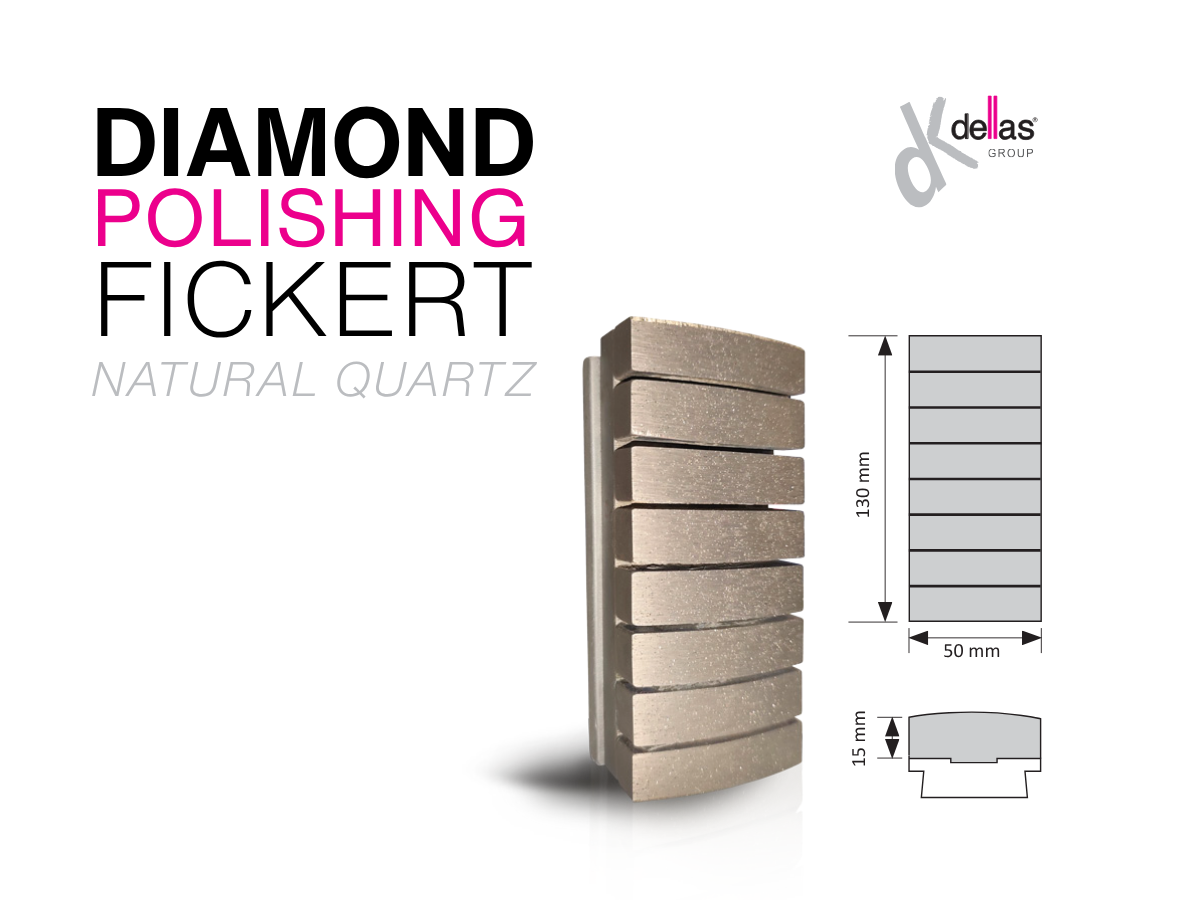
Maintaining consistent abrasive tool performance during the polishing of natural quartz is a key challenge for companies processing these materials. Their high hardness and resistance require tools capable of delivering effective and continuous material removal, while reducing interruptions and optimizing production costs.
Building on our experience in developing diamond tools for grinding and polishing natural stone, our Research & Development centre has worked on a new bond formulation to address a specific market requirement: maintaining the tool’s cutting ability for longer, in order to make full use of its entire service life.
When the tool loses cutting power before it is fully worn
One of the main challenges in quartzite polishing is the progressive loss of tool efficiency during processing. Over time, the abrasive surface may become “glazed”, meaning that the working surface gradually loses its ability to remove material effectively, making it increasingly difficult to maintain consistent performance. Under these conditions, the tool tends to slide over the surface rather than perform an effective and uniform abrasive action. As a result, the material is not properly levelled and surface irregularities may remain, affecting the subsequent processing stages. The issue therefore affects the entire process: if an adequate amount of material is not removed during the initial stages, the abrasives used later in the sequence, which are designed to progressively refine the surface, may not be able to compensate for the remaining imperfections.
The result is a suboptimal finish that does not achieve the desired levels of smoothness, uniformity and gloss, while also making surface porosity more visible. For companies, this means higher replacement costs, wasted product and less efficient management of processing times.
The Dellas solution: a new bond developed to promote uniform wear
The solution came from studying the bond. The Dellas R&D centre started from formulations that had already delivered good results and developed a new composition designed to improve the behaviour of diamond grains during the processing of natural quartzites.
The principle is to promote the diamond’s self-sharpening process by achieving the correct balance between the bond’s ability to retain the abrasive grains and their progressive wear. During processing, diamond grains are subjected to stresses that generate new cutting edges. If the bond retains the grains too strongly or limits their exposure, this process becomes less effective and the tool gradually loses its ability to remove material.
The new Dellas formulation, on the other hand, promotes more effective renewal of the cutting edges, allowing the diamond grains to maintain their abrasive action for longer, while the bond wears in a regular and controlled manner.
The result is better use of the abrasive material, more continuous processing and fewer premature tool replacements. This improvement translates into greater production efficiency and optimized processing costs.
Greater production efficiency and economic sustainability
The new formulation delivers benefits that go beyond the performance of the individual tool. More consistent abrasive action helps improve processing time management, while uniform wear allows a greater proportion of the product to be used before replacement becomes necessary.
For companies managing a grinding and polishing line, the benefits are tangible:
- More consistent performance: greater continuity of abrasive action throughout the process.
- Longer tool life: better use of the available abrasive material.
- Double optimization of processing time: fewer interventions caused by premature loss of efficiency and less need to repeat polishing stages.
- Reduced waste: less usable material discarded before the end of its effective service life.
- Economic sustainability: better use of resources and greater control over tool-related costs.
Reducing product waste also means taking a more responsible approach to resource use and contributing to more efficient production management.
Research starts with the needs of stone processors
This development reflects the way we at Dellas approach research and innovation every day: starting from proven solutions, listening to new market requirements and working on technical components to improve the final result through a customized approach.
Our knowledge of materials, polishing machines and different processing conditions allows us to develop increasingly specific tools, designed to meet real production requirements.
Every material and every production line has different characteristics. The Dellas technical team is available to analyse your requirements and identify the most suitable configuration.
Contact us to learn more about our new solutions for natural quartzite processing.