


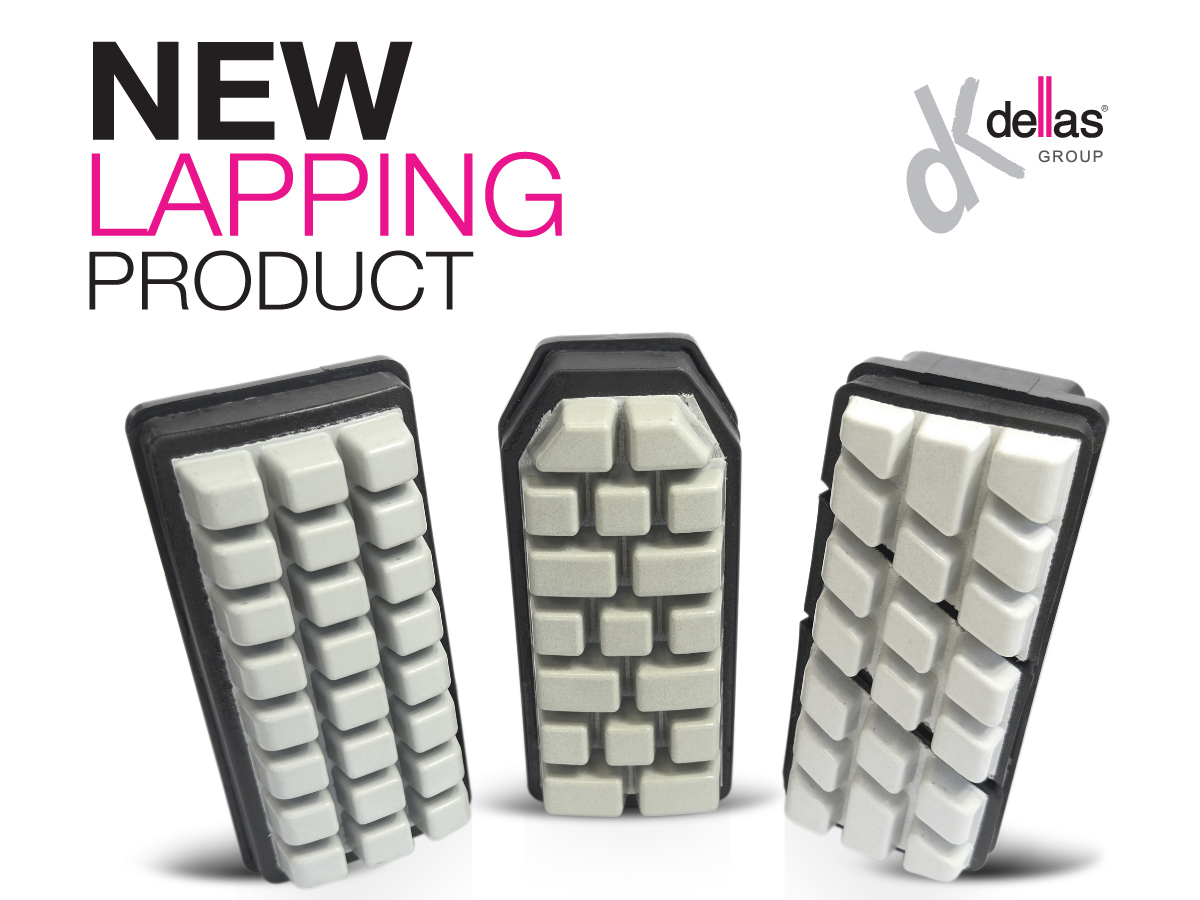
Dellas is expanding its range of tools for polishing ceramic tiles, introducing new solutions developed to meet the latest production requirements: greater control over material removal, improved flatness management, consistent performance and optimisation of production costs. This work stems from the in-house research and development centre, which is dedicated to the study of high-performance tools for machining the most modern materials. These materials, due to their technical characteristics, composition and behaviour on the production line, require increasingly specialised tools capable of adapting to different process conditions.
The new features introduced form part of a tried-and-tested range and represent a further step towards more efficient, consistent polishing that focuses on the final surface quality.
Two new ranges of L 140 mm tools
To address the challenges associated with the flatness of the material and controlled removal, Dellas has developed two new ranges of tools in the L 140 mm size, manufactured using compression moulding technology.
- The first version, comprising 24 rectangular segments, has been designed to adapt to surface irregularities and effectively follow variations in the material’s flatness, including any depressions in the substrate. This configuration allows the tool to operate more consistently, even on surfaces that are not perfectly uniform.
- The second version, comprising 17 inserts with an internal cusp, features a design intended to promote more even wear of the tool. The geometry helps to balance the stresses along the working periphery, improving the consistency of the work and the stability of performance over time.
New formulations for different production requirements
Alongside the development of new geometries, the Dellas R&D centre has also been working on new formulations, designed to specifically meet the diverse needs of production managers.
- The DM formulation is suitable for large terrazzo slabs characterised by different coefficients of thermal expansion and grain sizes. It stands out for its high cutting power and its ability to preserve flatness right from the early stages of levelling.
Configured on 17-segment tools, the DM formulation integrates effectively with subsequent 10-segment finishing stages and dedicated formulations, contributing to the creation of a flat and uniformly high-quality surface. - The YM6 formulation, on the other hand, has been developed to offer greater rigidity and versatility. It is suitable for both short production lines and high-throughput systems, even those with more than 40 heads. Its balance between stock removal capacity and service life allows for more flexible cutting control through pressure adjustment. In the 24-segment variant, divided into three independent sectors, the YM6 also increases resistance to lateral stress on the edges of the tiles, contributing to more stable and controlled machining.
Automation and cost optimisation
The new solutions for ceramic polishing do not only concern tool performance, but also the way in which they are manufactured. At our Verona plant, we have introduced new automated systems for the production of semi-finished products and for assembly processes. This optimisation programme enables us to improve internal production efficiency and keep manufacturing costs down, whilst maintaining the same high quality standards and consistent product performance. For buyers and ceramic manufacturers, this translates into a tangible benefit: more competitive solutions, developed to ensure continuity, reliability and quality over the long term.
Come and discover these two new developments at the Tecna trade fair in Rimini; from 22 to 25 September, you’ll find us in Hall B3, Stand 603.
Contact our experts directly on WhatsApp: